What is Dimpleplasty?
What is dimpleplasty, what does it do and what does it not do?
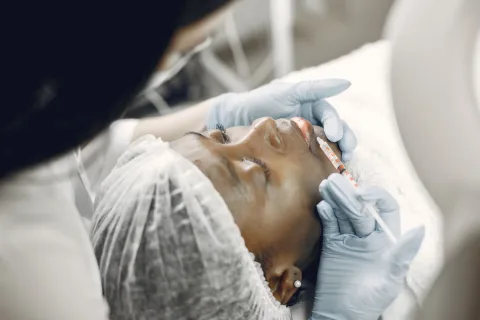
Dimpleplasty creates an indentation that appears when smiling by placing a small incision inside the cheek and suturing the skin to the underlying muscle. It is thought that natural dimples arise from splits or skin attachments in the fibers of the smiling muscle (zygomaticus major): when the muscle contracts, the skin is pulled inward at that point. Dimpleplasty mimics this attachment with a suture. The procedure is performed under local anesthesia, usually lasts 20–45 minutes, and patients go home the same day. Because the incision is inside the mouth, there is no externally visible scar on the face.
Dimpleplasty does not change the overall facial shape: it does not thin, fill or lift the cheek. If the concern is cheek fullness, this relates to buccal fat removal, a different procedure performed in the same area; removing buccal fat alone does not create a dimple. This page describes cheek dimples; a central chin indentation (chin dimple) and dimples in the lower back are different findings and are assessed separately.
How is the dimple location determined, should it be unilateral or bilateral?
The dimple's location is determined not by a single measurement but by your facial proportions while you smile. A commonly used starting point is the intersection of a vertical line dropped from the outer corner of the eye and a horizontal line from the corner of the mouth. However, studies of natural dimples show that more than half do not fall exactly on this point; they occupy different positions in long narrow faces compared with wide round faces. For this reason the point is also marked where the cheek naturally collapses during your smile and is checked together with you in a mirror.
Choosing unilateral or bilateral dimples is a personal preference. When a natural dimple exists on one side, a new dimple is planned to match its position and depth. In bilateral dimpleplasty, the position and depth of both sides are matched as closely as possible; small differences are normal because the two halves of the face are never exactly identical.
Why is the dimple visible at rest during the first weeks?
For the first 4–6 weeks after dimpleplasty the dimple may be visible at rest; this is expected. Because tissues relax as they heal, the suture is tied slightly tighter at the start than the intended final tension. Swelling is prominent in the early days and mostly subsides within about 2 weeks; then the dimple softens and in most people becomes predominantly noticeable when smiling. The final appearance usually settles by 3–6 months.
This period is important for planning: if you have a wedding, a photo shoot or a stage appearance within the next 4–6 weeks, choose the procedure date accordingly. It is premature to judge depth or side-to-side differences in the very early weeks.
Is the dimple permanent, can it fade over time?
Dimpleplasty aims for a long-lasting dimple; however, in some people the dimple may fade or disappear over time. The dimple is held by the intraoral suture and the scar tissue that forms around it. Techniques using non-absorbable sutures maintain the attachment longer; with absorbable sutures the resulting scar tissue eventually supports the dimple. The thickness of the cheek tissue, the pattern of smiling and individual healing affect how long the dimple remains prominent.
In a large published clinical series, approximately 8% of patients required a second procedure, most commonly due to insufficient initial depth or gradual loss of the dimple. Revisions are evaluated after tissues have settled. In the early period the dimple can usually be reversed by removing the suture; as time passes and scar tissue forms complete reversal may not always be possible. For this reason it is appropriate to decide with the understanding that the dimple is a permanent change.
Is a non-surgical dimple possible? Fillers, devices and makeup
A permanent dimple can only be created with a suturing procedure; fillers, devices or makeup do not create a true dimple. Procedures marketed as “incisionless” or “non-surgical” usually create the dimple with a suture placed through a needle, so risks such as infection, asymmetry and fading also apply to these methods. The table below compares the options.
| Option | What it does | Note |
|---|---|---|
| Dimpleplasty | Creates a collapsing point when smiling by suturing the skin to the underlying muscle from inside the mouth | Local anesthesia; visible at rest for the first 4–6 weeks |
| Filler | Adds volume to the injected area | Does not create a depression; not used to create a dimple |
| At-home dimple devices | Apply external pressure to the cheek | Not recommended; warned to potentially damage tissue and facial nerves |
| Makeup and photo filters | Mimic the appearance of a dimple | Temporary; carry no medical risk |
| Buccal fat removal | Reduces the fat pad inside the cheek to slim the face | Does not create a dimple; performed for a different purpose |
Filler can be considered for volume loss in areas such as the cheeks or lips; however it is not a solution for creating a dimple.
Comparing offers and coming from out of town
When comparing dimpleplasty offers, look at what is included before comparing the total price. Two procedures with the same name may differ in technique and follow-up. Asking the following questions helps you compare offers meaningfully:
- Will the dimple be unilateral or bilateral, and how will the location be determined?
- Which technique and which type of suture (absorbable or non-absorbable) will be used?
- Who will perform the procedure; are anesthesia, medications and follow-up visits included?
- What are the conditions for revision if the dimple fades or there is a side-to-side difference?
Dimpleplasty for cosmetic purposes is not covered by SGK. The clinic is located in Kadıköy on the Asian side of İstanbul. Patients coming from out of town usually stay in İstanbul for 2–3 days after the procedure; the first follow-up can be done during this period. Pre-assessment photos can be shared in advance; however the final dimple location is determined face-to-face while you smile during the examination.
What the procedure can address
Not every patient receives the same treatment; the points below may be considered together or separately, depending on the person:
- 01Desire for a visible cheek dimple when smiling
- 02Having a natural dimple on only one side and wanting a matching dimple on the other side
- 03Enhancing a subtle or very shallow natural dimple to make it more noticeable
- 04Correcting a previously created dimple that has faded, remained shallow or is asymmetric between sides
Who may be a candidate?
Who may be a candidate?
Dimpleplasty is performed on individuals whose facial growth is complete, who are at least 18 years old and in good general health. It is important that there is no active infection in the mouth, teeth or gums, that any condition that impairs wound healing is controlled, and that expectations are realistic. The most suitable candidates accept from the start that the dimple may be visible at rest for the first 4–6 weeks, that the final appearance settles in 3–6 months, and that the dimple may fade over time. The thickness of the cheek tissue also affects how prominent the dimple will be and is assessed during the examination.
Who may not be suitable?
- Being under 18 years old
- Active infection in the mouth, gums or cheek, or an untreated dental problem
- Keloid-prone scarring tendency; requires careful and separate evaluation
- Bleeding disorder or anticoagulant therapy that the physician advises not to stop
- Uncontrolled diabetes or immunosuppressive therapy (increased infection risk)
- Pregnancy and breastfeeding period (procedure is postponed)
- Inability to accept that the dimple may be visible at rest in the early weeks or having an important event in the near future (the date should be rescheduled)
Dimpleplasty does not change facial shape; it does not thin or fill the cheeks. The goal is to add a small detail to the smile that suits the patient's face.
The doctor's examination approach
The examination looks beyond appearance to the person's overall anatomy and expectations. Key points assessed:
- Point where the cheek collapses when smiling
- Facial height and width
- Existing or subtle dimple
- Subcutaneous tissue and fat thickness
- Differences between the right and left cheeks
- Teeth, gums and salivary duct openings
- Previous filler, thread suspension, buccal fat removal
- Unilateral or bilateral, desired depth
The process
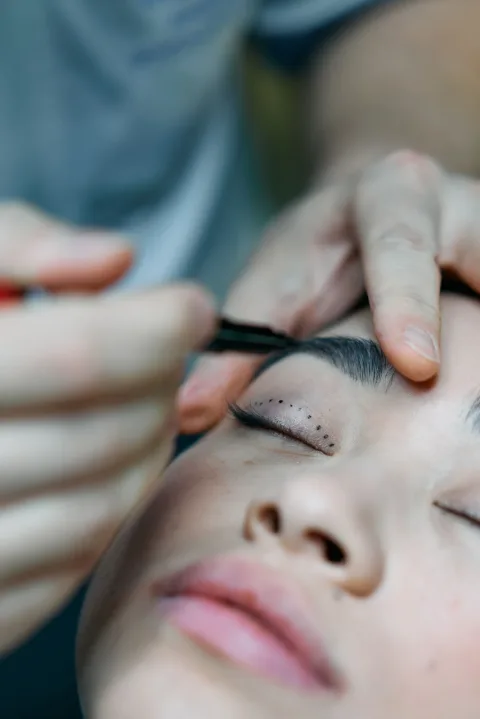
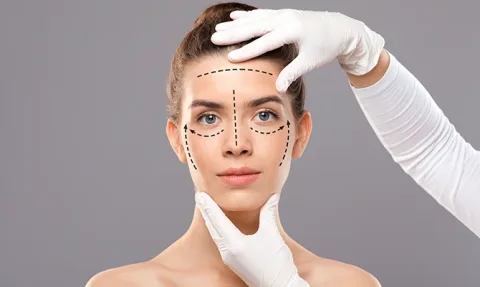
During the examination your face is evaluated from the front and side, at rest and with different types of smile (with lips closed and with teeth visible); photographs are taken for planning. The dimple position is marked on the skin while you are seated and smiling and is checked together with you in a mirror. Whether the dimple will be unilateral or bilateral, the desired depth, the technique and suture type to be used, the expected early appearance and the timing of the procedure relative to upcoming events are discussed clearly.
-
1
Examination and smile analysis
Facial proportions, presence of a natural dimple and cheek tissue are evaluated; expectations are discussed.
-
2
Marking
The dimple location is marked on the skin while you smile and is checked together in a mirror.
-
3
Local anesthesia
The inner cheek and the marked point are anesthetized; light sedation can be added for anxious patients.
-
4
Procedure
A few-millimeter incision is made through the intraoral mucosa, a small amount of tissue is removed if needed, and the skin is sutured to the underlying muscle. The procedure generally lasts 20–45 minutes.
-
5
Discharge
Patients go home the same day; written instructions are provided regarding diet, oral care and medications.
-
6
Follow-up
The first follow-up is done in the early days; the dimple's settling is followed over 3–6 months.
Technique and medical approach
The method depends on the patient; no single technique suits everyone. Main points considered:
| Approach | Description |
|---|---|
| Suture fixation | A suture is placed between the underside of the skin and the cheek muscle through a small intraoral incision; the dimple depth is adjusted by the suture tension. Because no tissue is removed the procedure is short; in patients with thicker cheek tissue the dimple may be more likely to fade. |
| Small tissue excision and suture | A small amount of muscle and fat tissue is removed beneath the dimple point, and then the skin is sutured to the muscle. The resulting scar tissue supports the dimple; this technique may be preferred in patients with thicker cheek tissue. |
| Non-absorbable and absorbable sutures | Non-absorbable (permanent) sutures maintain the attachment longer; with absorbable sutures the resulting scar tissue eventually supports the dimple. The suture type to be used is explained during the examination based on cheek tissue and expectations. |
| Unilateral or bilateral dimple | A unilateral dimple adds a natural asymmetry to the face; in bilateral dimpleplasty the position and depth of both sides are matched. When a natural dimple exists on one side, a new dimple is planned to align with it. |
| Revision of a previous dimple | A dimple that is shallow, faded, excessively deep or asymmetric is re-evaluated after tissues have settled; the suture can be renewed or loosened. |
Preparing for the procedure
The points below are general information and do not replace personal medical instructions. Your own preparation is set at the examination.
Recovery
-
Day 0
Procedure day
Numbness lasts for several hours; avoid eating until numbness wears off to prevent biting the cheek. Cold application reduces swelling; patients go home the same day.
-
Days 1–3
First days
Consume liquids and soft foods and rinse the mouth after meals as advised by your dental/oral care provider. The first follow-up is usually during these days; most people return to desk work.
-
Days 4–7
First week
Sensitivity decreases; avoid hard, crunchy and very hot foods during the first week. Do not massage the cheek.
-
Weeks 1–2
First two weeks
Swelling largely subsides; the dimple is noticeable at rest. Return to exercise after physician approval, typically after 2 weeks.
-
Weeks 3–6
First weeks
As the initial suture tension relaxes the dimple softens; its visibility at rest gradually decreases.
-
Months 3–6
Months
In most people the dimple is primarily noticeable when smiling and the final appearance settles; revision, if needed, is considered after this period.
Tightness and sensitivity in the cheek are common in the first days after dimpleplasty; pain is usually controlled with prescribed analgesics. Increasing redness and warmth of the cheek, purulent discharge from inside the mouth, fever or progressively increasing swelling may indicate infection; contact the surgical team without waiting for the scheduled follow-up. Do not manipulate the intraoral suture with the tongue or fingers.
Results and realistic expectations
The result of dimpleplasty settles over 3–6 months: the depression that is visible at rest in the early weeks softens and in most people becomes primarily noticeable when smiling. Dimple depth varies with the type of smile; it may appear deeper with a smile where the lips are closed compared with a wide smile showing the teeth. Results vary between individuals; the dimple can fade over time or a depth difference may remain between sides. In such cases revision is evaluated after tissues have settled.
Before and after
Results vary from person to person.
Risks and limitations
Dimpleplasty is a minor procedure, but like any surgical intervention it carries risks. The most common issues relate to appearance rather than health: the dimple may be shallower or deeper than expected, asymmetric between sides, or may fade over time. In a large published clinical series about 8% of patients required a second procedure for these reasons.
- The dimple being shallower than expected or not forming at all
- The dimple fading or disappearing over time
- The dimple being excessively deep or remaining noticeable at rest for a long time
- Difference in position or depth between sides (asymmetry)
- Infection, purulent discharge from the mouth or tissue reaction to the suture (rarely requiring suture removal)
- Bleeding, swelling and bruising
- Rarely, involvement of the salivary duct (Stensen's duct) or branches of the facial nerve to the cheek
- In techniques where the suture is passed through the skin, a small entry point scar
Alternative and complementary options
In some cases other methods may be considered. Each has its own limits and is not right for everyone:
| Method | Description |
|---|---|
| 1Makeup and photo filters | Mimic the appearance of a dimple; temporary and risk-free, but do not create a real indentation in the smile. |
| 2Filler | Fillers add volume; a dimple is a depression that pulls the skin inward. Therefore fillers are not used to create a dimple; they are considered only for volume in areas such as the cheeks or lips. |
| 3At-home dimple devices | Devices that claim to create a dimple by external pressure on the cheek are not recommended; they may damage underlying tissue and cause problems in facial nerves and muscles. |
| 4Buccal fat removal | Reduces the fat pad inside the cheek to slim the face; does not create a dimple. If cheek fullness is the concern, this is assessed as a separate procedure. |