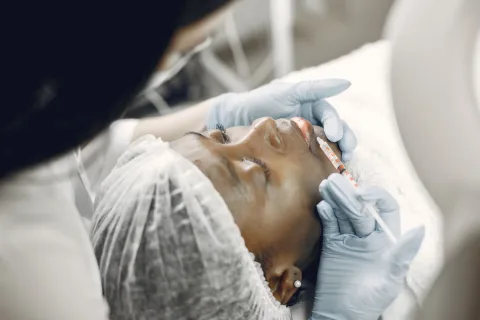
What is Chin Implant?
What is a chin implant, what does it correct and what does it not correct?
Chin implant (mentoplasty with implant) is an operation that supports a retruded or small chin point forward and, if needed, laterally by placing a prefabricated implant on top of the bone. In medicine, a small chin is called microgenia and a retruded chin point is referred to as retrogenia. The implant is placed in a narrow pocket created under the periosteum; in profile view this balances the lips and chin point and makes the nose appear more proportionate to the face.
A chin implant does not change the dental occlusion; if mandibular retrusion is accompanied by malocclusion the problem is at the bone level and orthognathic surgery planned together with orthodontic treatment is considered. Vertical shortness or excess of the chin, submental fat (double chin) and skin laxity under the chin are not corrected by an implant.
Implant, sliding genioplasty, filler and fat grafting: which is suitable for whom?
An implant is not the only way to advance the chin point; the method is chosen according to the direction and amount of the deficiency, dental occlusion and the expectation of permanence. The table below summarizes the general differences between these methods; the personal plan is made during the examination.
| Method | How is it done? | Who is it considered for? | Points to consider |
|---|---|---|---|
| Chin implant | An implant is placed on the bone | Those with normal occlusion and mild–moderate retrusion of the chin point | Permanent, removable if necessary; monitor for infection and displacement |
| Sliding genioplasty | The chin bone is cut and repositioned, fixed with plates and screws | Marked retrusion, vertical shortness or excess of the chin, asymmetry | No foreign material; longer recovery and sensory changes are more common |
| Chin filler | Hyaluronic acid filler is injected with a needle | Mild retrusion, those who do not want surgery | Temporary; insufficient for large deficiencies |
| Fat grafting | The patient's own fat is injected into the chin | Mild volume deficiency | Some is resorbed; multiple sessions may be required |
| Orthognathic surgery | Jaw bones are repositioned in conjunction with orthodontic treatment | Those with retrusion accompanied by dental occlusion problems | A comprehensive treatment planned with orthodontics |
In mild retrusion, chin filler can be used and also serves to preview the new profile before surgery.
Nose and chin together: profile balance
A retruded chin can make the nose appear larger and a prominent chin can make the nose look smaller; therefore chin implant is often planned together with rhinoplasty. In some people who present for rhinoplasty, the primary imbalance is the chin and treating only the nose will not fully balance the profile. The forehead, nose, lips and chin point are evaluated together in profile during the examination; if necessary a chin implant is performed in the same operation as rhinoplasty. This combined approach prolongs the operation time but is completed with a single anesthesia and a single recovery period.
Relationship between the chin point, jawline and neck
The position of the chin point also affects the appearance of the neck: a retruded chin blunts the chin–neck angle and can make the submental area appear fuller. Therefore, in some patients a chin implant alone clarifies the neck line. If there is significant submental fat, skin laxity or neck muscle bands, liposuction under the chin or a neck lift should be added to the implant; because the submental incision can also be used for these procedures, it is often preferred in combined plans. For the prejowl depression that occurs anterior to the jawline with aging, winged implants extending laterally can be considered together with a facelift.
Incision site, implant material and male–female differences
A chin implant is placed either through the inner surface of the lower lip (intraoral) or via a short incision near the natural fold under the chin. The intraoral approach leaves no external scar but requires meticulous oral hygiene in the early days. The submental approach leaves a fine scar; on the other hand the implant position is easier to control. In both approaches the mental nerve that supplies sensation to the chin and lower lip is protected.
The most commonly used implant materials are medical-grade silicone and porous polyethylene. Silicone is flexible, forms a thin tissue capsule around it and can be removed more easily if necessary. Porous polyethylene is firmer; tissue grows into its pores so it adheres firmly but is more difficult to remove. Systematic reviews in the literature do not show a clinically significant difference in overall complication rates between the common materials.
In men a wider, more angular chin is usually desired, while in women a forward-projected but narrower chin point is preferred; therefore two people with the same degree of retrusion may receive implants of different shape and size.
How to compare chin implant offers?
When comparing chin implant offers, look at what is included in the proposal before comparing the total price. Two operations with the same name may be a standalone implant or an operation planned together with rhinoplasty and neck procedures. The following questions help you truly compare offers:
- Is the proposed method an implant or sliding genioplasty; why was this method chosen?
- What material, shape and size of implant will be used?
- Will the incision be intraoral or submental?
- What type of anesthesia is used; are anesthesia, operating room and any hospital fees included?
- Are additional procedures such as rhinoplasty or submental liposuction charged separately?
- What follow-up visits, medications and conditions for possible revision are included?
Cosmetic chin implant is not covered by SGK; cases with medical indications are evaluated separately. Note that dental implants, which are often confused in search results, are screws placed into the jawbone to replace missing teeth and are unrelated to this operation.
What the procedure can address
Not every patient receives the same treatment; the points below may be considered together or separately, depending on the person:
- 01A retruded or small chin point in profile
- 02Profile imbalance that makes the nose appear large relative to the face
- 03Loss of definition in the jawline and a blunt chin–neck angle
- 04A chin point that appears narrow or weak from the front
- 05Prejowl depression and mild asymmetry of the chin point
Who may be a candidate?
Who may be a candidate?
A suitable candidate for a chin implant is someone whose dental occlusion is normal or near-normal, whose chin point is mildly–moderately retruded in profile and who is bothered by this appearance. Facial bone growth should be complete; therefore aesthetic chin implantation is usually planned after age 18. Patients in good general health, able to stop smoking, with stable weight and realistic expectations are better candidates. If there is malocclusion, marked asymmetry or vertical shortness/excess of the chin, sliding genioplasty or orthognathic surgery may be preferred instead of an implant.
Who may not be suitable?
- Mandibular retrusion accompanied by dental malocclusion (in this case orthodontics and orthognathic surgery are considered)
- Marked vertical shortness or excess of the chin (implant does not correct vertical height)
- Active intraoral infection, untreated dental or periodontal disease
- History of reaction to implant material or previous implant rejection
- Inability to stop smoking before surgery or uncontrolled diabetes or cardiovascular disease
- Incomplete development of facial bones
A chin implant is performed not to change a person's facial character but to make the chin point proportionate to the nose, lips and neck. The goal is not a large chin but a chin point harmonious with the face.
The doctor's examination approach
The examination looks beyond appearance to the person's overall anatomy and expectations. Key points assessed:
- Relationship of the nose, lips and chin point
- How retruded the chin point is
- Vertical height of the chin
- Frontal chin width and symmetry
- Dental occlusion
- Skin, muscle thickness and the chin point during smiling
- Submental area and chin–neck angle
- Previous fillers, fat grafting or surgeries
The process
During the examination the face is evaluated frontally, in profile and while smiling; standard photographs are taken for profile analysis. The degree of chin retrusion, vertical height, width, dental occlusion and submental anatomy are assessed together; radiographs are requested if necessary. Whether an implant or sliding genioplasty is appropriate, the implant's shape and size, incision site, anesthesia type and whether nose or neck procedures will be added are discussed clearly.
-
1
Examination and profile analysis
The face is examined frontally and in profile, dental occlusion is checked, and expectations and previous procedures are discussed.
-
2
Method and implant selection
Choice between implant, sliding genioplasty or non-surgical options; determination of implant shape, size and incision site.
-
3
Preparation
Investigations are completed; instructions are given regarding smoking, medications and dental/oral health.
-
4
Surgery
Takes about 1 hour under sedation or general anesthesia; the implant is placed into a pocket under the periosteum and the incision is closed.
-
5
Immediate hours
A supportive chin band is applied; after a short observation most patients go home the same day.
-
6
Follow-ups
The band and external dressings are removed within the first week; healing is followed with scheduled check-ups.
Technique and medical approach
The method depends on the patient; no single technique suits everyone. Main points considered:
| Approach | Description |
|---|---|
| Intraoral implant | The incision is made on the inner surface of the lower lip, leaving no external scar. In the first days pay attention to oral hygiene after meals and use the prescribed mouthwash. |
| Submental implant | Access is via a short incision near the natural fold under the chin. Implant position is easier to control; suitable for combining with submental liposuction or neck lift, leaving a fine scar. |
| Winged (extended) anatomical implant | An implant that extends laterally from the chin point provides support not only forward but along the jawline. Considered for prejowl depression and chins that appear narrow from the front. |
| Sliding genioplasty (osteotomy) | The chin bone is cut from inside the mouth and advanced forward, upward or downward and fixed with plates and screws. Considered instead of an implant in marked retrusion and when vertical correction is also needed. |
| Combined with rhinoplasty or neck procedures | For profile balance a chin implant can be planned in the same operation as rhinoplasty, or for submental contouring combined with liposuction or a neck lift. |
Preparing for the procedure
The points below are general information and do not replace personal medical instructions. Your own preparation is set at the examination.
Recovery
-
0–1 day
Surgery day
Most patients go home the same day. A support band is worn on the chin; keep the head elevated and apply cold compresses. Consume liquids or soft foods for the first 1–2 days.
-
2–7 days
First week
Swelling and tightness are most pronounced; numbness in the lower lip may occur. The band and external dressings are removed within the first week at the follow-up.
-
7–10 days
Return to work
Most people return to work and social life; bruising, if present, is largely resolved.
-
2–6 weeks
Initial weeks
Most swelling subsides around 6 weeks. Heavy exercise and contact sports may be resumed after 4–6 weeks with physician approval.
-
6th week–3 months
First months
Numbness in the chin and lower lip usually improves by 3 months; the chin softens and regains natural movement.
-
3–6 months
Final appearance
Residual swelling resolves; the final shape of the chin point and the profile balance become clear.
In the first days after a chin implant patients feel tightness, swelling and numbness of the lower lip more than pain; pain is generally controlled with prescribed medications. If you experience rapidly increasing swelling, redness, fever, discharge from the incision, or a sensation that the implant has shifted, contact the surgical team without waiting for the scheduled appointment; seek emergency medical care for shortness of breath or chest pain.
Results and realistic expectations
Changes in the chin point are noticeable immediately after surgery, but as swelling subsides the final appearance becomes clear within 3–6 months. The implant does not dissolve and remains in place unless removed; however, the surrounding soft tissues change with aging. The goal is for the implant not to be visible externally; when palpated it should feel firm like bone. Submental fat, skin laxity and dental occlusion are not altered by the implant and may require separate procedures.
Before and after
Results vary from person to person.
Risks and limitations
The risks of a chin implant are explained before surgery according to the patient's health status and the chosen method. Because the implant is a foreign body, infection and implant displacement are the most closely monitored issues; intraoral incisions, smoking cessation and regular use of prescribed medications reduce these risks.
- Infection; may rarely require removal of the implant
- Implant displacement or asymmetry
- Usually temporary numbness of the lower lip and chin (involvement of the mental nerve)
- Collection of blood or fluid under the skin (hematoma, seroma)
- Hardening around the implant (capsular contracture)
- Superficial bone loss under the implant (bone resorption)
- Noticeable scar at the submental incision or delayed wound healing
- Dissatisfaction with size or shape and the need for revision surgery
- Anesthesia-related risks
Alternative and complementary options
In some cases other methods may be considered. Each has its own limits and is not right for everyone:
| Method | Description |
|---|---|
| 1Chin filler | Hyaluronic acid filler provides non-surgical support for mild retrusion and allows previewing the new profile; it is temporary, its effect decreases over months and it is insufficient for large deficiencies. |
| 2Fat grafting | Adds soft volume using the patient’s own fat; some of the transferred fat is resorbed, multiple sessions may be necessary and it does not provide a distinct chin point shape. |
| 3Sliding genioplasty | Repositions the patient's own bone forward, upward or downward; contains no foreign material and can correct vertical problems as well, but the surgery and recovery are longer. |
| 4Orthognathic surgery | Planned with orthodontics when mandibular retrusion is accompanied by dental occlusion problems; an implant does not correct occlusion in this case. |